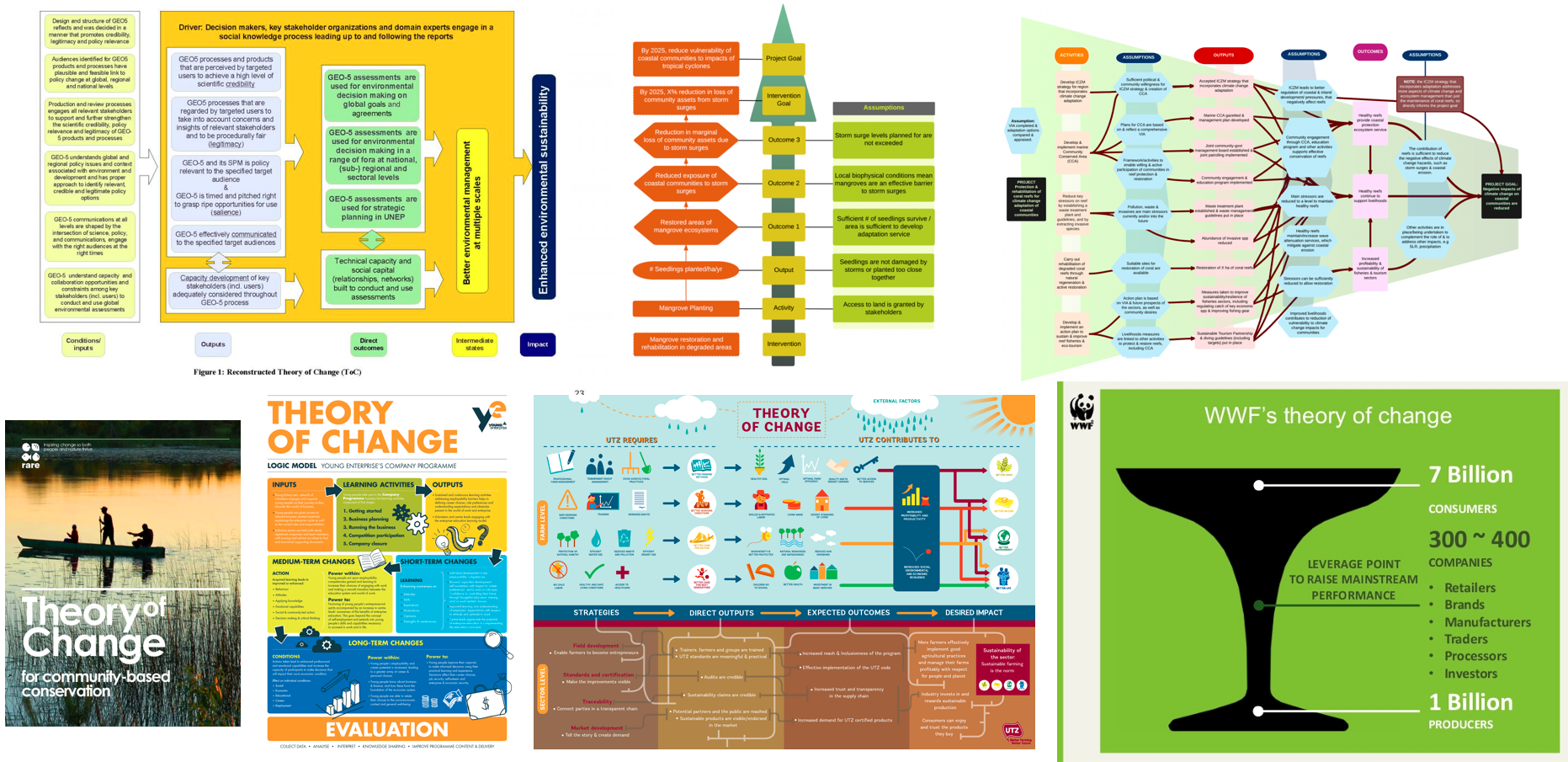
This research project investigates clashing perspectives within the environmental movement over how to apprehend the shifting terrain — and the corresponding strategic implications — of our current conjuncture. My specific entry point into these questions is through “theories of change.” Typically, a theory of change outlines key beliefs, hypotheses, and assumptions about how social change works. These are usually depicted through narrative and causal chain diagrams portraying how a group envisions and intends to enact change in its context. As organizational devices, theories of change have proliferated widely from their origins in the fields of evaluation and international development across a range of other mission-driven initiatives, including but by no means limited to climate and sustainability.
I contend that theories of change are more than just tools for strategic planning. They can also serve as revealing windows into pivotal tensions at the heart of movement strategy and organizing, encompassing longstanding debates between reformers and radicals, insiders and outsiders, incrementalists and revolutionaries, and among a dense array of professed (and mutually opposed) realists. Through our research, my group has analyzed how these movement tensions are negotiated and managed in organizational context by analyzing the theory of change models produced within different environmental and climate advocacy groups. By foregrounding the implicit logic underpinning pervasive claims about how change is actually supposed to happen — essentially, forcing advocates to “show their work” — theories of change require aspiring change-makers to talk openly about, and thereby directly confront and reckon with, fundamental disagreements about the nature of power, political economy, history, social change itself, and how to properly relate to established patterns of social order.
By design, theories of change render these questions uniquely and unavoidably explicit. They thus offer revealing glimpses into the social construction of political “common sense” among movements: vivid portraits of how activists of varying stripes are wrestling with the political meaning of the current moment and what can, and should, be done about it. Through interviews, participant observation, and close, comparative analysis of theory of change formulation processes, this project explores how self-styled practitioners of social change think about the basic parameters of social change: what it is, what it looks like, how it happens, and how to do it.

